
Hotplates & Stirrers
Hotplates heat beakers and flasks on the bench, magnetic stirrers mix liquids with a spinning stir bar, and hotplate stirrers do both at once. CSI Labshop supplies all three to chemistry, food, QC, university and research laboratories across Malaysia, from small single-position stirrers to 15-position units.
Tell us your typical volume, the temperature you need and what you are heating, and we will suggest a suitable model and send a quotation.
How laboratories use hotplates and stirrers
- Preparing reagents and buffers: A stirrer dissolves salts quickly and keeps the solution even while you adjust the pH.
- Palm oil and fat testing: Samples are melted and mixed before they are weighed, so the portion is representative.
- Microbiology: Agar and media are dissolved and heated before autoclaving.
- Parallel tests: Multi-position stirrers such as the DAIHAN SMHS run several samples under the same conditions.
Types of hotplates and stirrers
- Hotplate stirrers heat and stir in one unit, the everyday choice for preparing solutions and media. See the IKA RCT basic, IKA RET basic, IKA C-MAG HS 7, Daihan digital hotplate stirrer and FAVORIT HS0707V2.
- Hotplates without stirring suit digestion, evaporation and heating vessels that cannot take a stir bar. See the IKA C-MAG HP 7, Daihan large digital hotplate and FAVORIT HP0707V2.
- High-temperature hotplates reach up to 500 °C on a solid ceramic glass plate. See the Daihan MaXtir 500H and the Daihan 500 °C hotplate stirrers.
- Magnetic stirrers without heating for mixing at room temperature, from the mini IKA Topolino (up to 250 ml, also as a battery Topolino mobil) to the IKA KMO 3 basic, C-MAG MS 7, Midi MR 1 digital for up to 50 litres and the FAVORIT ST0707V2.
- Multi-position stirrers run several samples side by side under the same conditions. See the IKA RO 10 (stirring only), the IKA RT 10 (heating and stirring) and the Daihan SMHS multi-hotplate stirrers with independent control of each plate.
- Circulators and thermostats hold a bath or connected vessel at a set temperature, including below room temperature. See the LAUDA Alpha RA 8 (−25 to 100 °C) and the Huber Ministat 230 (−40 to 200 °C), which is small enough to stand in a fume cupboard.
How to choose a hotplate stirrer
- Plate material: ceramic glass resists acids and cleans easily; aluminium heats faster and more evenly; stainless steel is the economical option.
- Volume: check the maximum stirring quantity (litres of water) and the plate size against your largest vessel.
- Temperature control: for an exact liquid temperature, choose a model that takes an external probe (PT1000 contact thermometer), such as the IKA RCT and RET ranges.
- Safety: look for a fixed safety circuit and a hot-plate warning, especially for unattended or solvent work.
Brands we can supply
- IKA (Germany): C-MAG, RCT, RET, RH and multi-position stirrers
- Daihan Scientific (Korea): digital, premium, high-temperature and multi-hotplate stirrers
- FAVORIT: compact hotplate, stirrer and stirring hotplate
- LAUDA (Germany): circulators and cooling thermostats
- Huber: Ministat 230 cooling circulator
Frequently asked questions
What is the difference between a hotplate and a hotplate stirrer?
A hotplate only heats. A hotplate stirrer also has a magnetic drive under the plate that spins a stir bar in the vessel, so the liquid heats evenly without stirring by hand.
Ceramic or aluminium plate?
Choose ceramic glass for corrosive chemicals and easy cleaning. Choose aluminium when fast, even heating matters more, for example with round-bottom flasks in a heating block.
How hot does a laboratory hotplate get?
Depending on the model, the plate surface reaches about 300 to 500 °C. The liquid inside the vessel is always cooler than the plate.
How much does a hotplate stirrer cost in Malaysia?
The price depends on plate size and material, maximum temperature, digital control and the number of positions. Send us your requirements for a quotation.
-
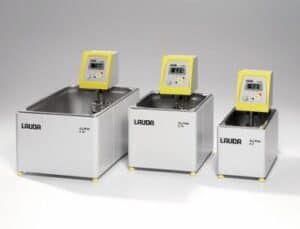
Circulators & Thermostats (2)
-

Daihan Hotplate Stirrer (10)
-

Favorit Hotplate Stirrer (4)
-

IKA Hotplates & Stirrers (54)

Not sure which model fits?
Tell us your application, sample type and budget. We’ll suggest suitable models from the brands we supply and send one quotation.